
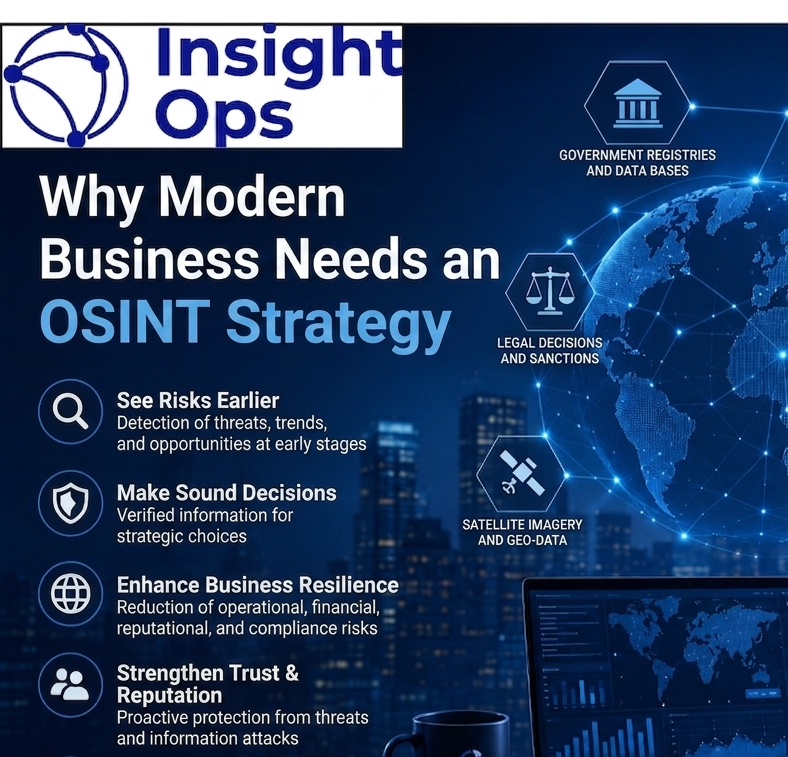
In today’s world, information has become as strategic a resource as financial capital or intellectual property. Markets are changing at an unprecedented pace, geopolitical risks emerge almost instantly, supply chains are becoming increasingly vulnerable, and reputational crises often begin long before they make headlines.
Under these conditions, companies can no longer rely solely on internal reporting or traditional security measures. Effective risk management requires the ability to identify potential threats early, understand the environment in which a business operates, and make decisions based on verified intelligence.This is why OSINT (Open Source Intelligence) is becoming increasingly important—a systematic process of collecting, analyzing, and interpreting information from publicly available sources.
These sources include government registries, corporate databases, sanctions lists, court records, procurement platforms, media outlets, social networks, satellite imagery, academic publications, leaked datasets, and dozens of other information resources. However, the true value of OSINT lies not simply in access to open information but in the methodology used to locate, verify, correlate, and analyze it. A professional analytical approach transforms thousands of isolated data points into a comprehensive picture of business risks and opportunities.
Many people still associate OSINT primarily with investigative journalism or law enforcement activities. In reality, open-source intelligence has become one of the key components of corporate security, compliance, and risk management within leading international companies.
The growing importance of OSINT is clearly demonstrated by the practices of some of the world’s largest corporations. Today, multinational companies view open-source intelligence not as a standalone investigative tool but as an integral part of their corporate strategy. Corporate security and risk analysis teams routinely combine publicly available information with internal company data to support strategic decision-making. Microsoft integrates external cyber threat intelligence into its global security ecosystem, while Shell and BP have relied on geopolitical monitoring and open-source analysis for years to assess operational risks across different regions of the world. Maersk, one of the world’s largest logistics companies, continuously analyzes open-source information to anticipate risks related to political instability, sanctions, cyberattacks, and disruptions to transportation corridors. Likewise, major international financial institutions, including HSBC and JPMorgan Chase, have integrated OSINT into their compliance procedures, sanctions screening, anti-money laundering (AML) programs, and enhanced due diligence processes. These examples demonstrate that OSINT is no longer a niche investigative capability but a fundamental element of corporate resilience.
The practical value of OSINT is best illustrated through real-world examples.
Following Russia’s full-scale invasion of Ukraine in 2022, hundreds of international companies were forced to reassess their supply chains within days. Organizations already using geopolitical monitoring and open-source intelligence were able to quickly identify suppliers linked to sanctions risks, Russian beneficial owners, or regions where logistics had become impossible. Companies relying solely on traditional due diligence procedures often encountered problems only after contracts had been signed or business operations had already begun.
OSINT also plays a critical role in the financial sector. Banks and international financial institutions increasingly rely on open-source intelligence during Know Your Customer (KYC) and Anti-Money Laundering (AML) procedures. Analysis of corporate registries, court records, beneficial ownership information, sanctions databases, and leaked corporate documents often reveals hidden relationships, politically exposed persons (PEPs), or indirect connections to sanctioned entities before business relationships are established.
Cybersecurity has become another major area where OSINT delivers substantial value. Before cyberattacks or large-scale disinformation campaigns become visible, threat actors often leave digital traces on specialized forums, open-source code repositories, social media platforms, and other publicly accessible online spaces. Continuous monitoring of this information environment enables organizations to detect emerging threats and implement preventive measures before incidents occur.
Open-source intelligence also makes a significant contribution to protecting corporate reputation. Reputational crises rarely arise without warning. Negative social media discussions, coordinated information campaigns, customer complaints, internal conflicts, or disinformation efforts typically accumulate gradually. Companies that systematically monitor these early signals gain valuable time to verify information, prepare communication strategies, and minimize potential reputational damage.
An effective OSINT strategy enables businesses to shift from reactive crisis management to proactive risk prevention. Rather than responding after problems have already emerged, organizations can identify early warning signs and make informed decisions based on continuously updated analytical intelligence.
It is equally important to understand that OSINT is not about collecting as much information as possible. Most organizations already face information overload. The real value of open-source intelligence lies in transforming vast amounts of fragmented data into structured, verified, and actionable intelligence that supports informed business decision-making.
Modern artificial intelligence technologies have significantly expanded the capabilities of OSINT analysis. Automated information discovery, large-scale data analysis, multilingual source translation, and identification of hidden relationships between individuals or companies all accelerate analytical workflows. However, even the most advanced algorithms cannot replace human expertise. It is the analyst who evaluates source credibility, understands political and legal contexts, distinguishes facts from manipulation, and develops analytical conclusions that ultimately support executive decision-making.
Building an OSINT strategy does not necessarily require establishing a large intelligence department. For many organizations, integrating open-source intelligence capabilities into existing compliance, legal, procurement, corporate security, or cybersecurity functions is sufficient. As the business grows, these capabilities can gradually evolve into dedicated corporate intelligence units.
In today’s environment of geopolitical instability, uncertainty has become a permanent feature of doing business. Sanctions, cyberattacks, fraud, information operations, political crises, and supply chain disruptions can directly affect virtually any organization, regardless of its size or industry.
For this reason, OSINT is no longer simply an investigative methodology. It has become a strategic business function that enhances organizational resilience, strengthens corporate governance, protects reputation, and supports better-informed decision-making. Companies that invest in building systematic open-source intelligence capabilities today gain more than just access to information—they gain the ability to identify risks earlier, adapt more quickly to change, and build a sustainable competitive advantage.