
Buying an apartment or investing in real estate is a decision where the cost of a mistake can be very high. At first glance, checking a real estate developer may seem to involve reviewing the official website, residential complex presentation, residents’ reviews, and information about previously completed projects.
However, this is often not enough to build a comprehensive picture of the company and the people behind a particular development. A developer may operate through several legal entities, have a complex ownership structure, engage different contractors, or change companies associated with individual projects. Some important information may not be available on official resources but may instead be found in court decisions, state registers, media publications, professional profiles, archived versions of websites, documents, or digital traces left by the company and its representatives over many years.
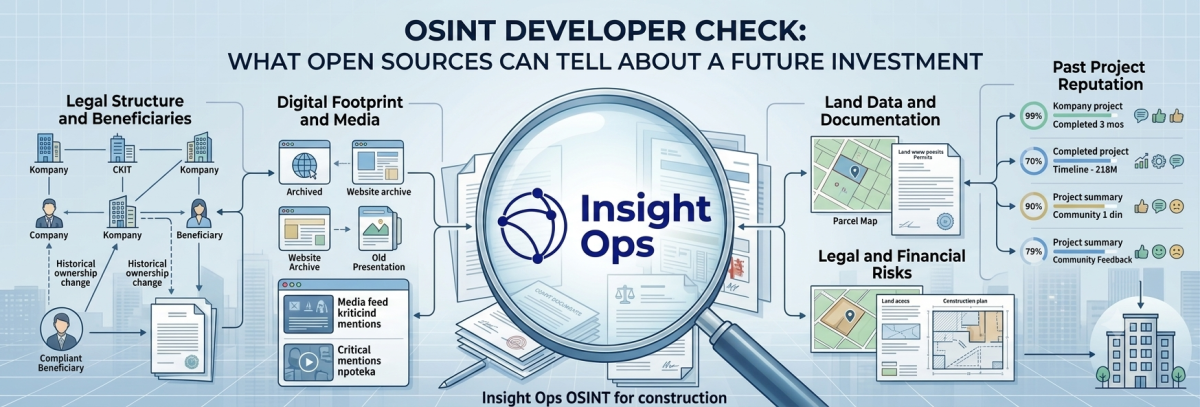
This is where OSINT — Open Source Intelligence, or the collection, verification, and analysis of information from publicly available sources — can be useful. In the real estate context, OSINT makes it possible to look at a developer beyond its marketing materials: to examine its corporate and business history, identify connections between companies and individuals, assess its reputation and previous projects, and identify factors that may require additional legal or financial due diligence.
From the Residential Complex Brand to the People Behind It
One of the first questions when checking a developer is who exactly is implementing the project. The name of a residential complex or development brand does not always correspond to the name of the legal entity that acts as the developer, owns the land plot, or enters into agreements with investors.
OSINT research makes it possible to map this structure and identify legal entities, founders, ultimate beneficial owners, and directors, as well as trace the relationships between them. What matters is not only who is formally listed in the registers today, but also how the company structure has changed over time.
For example, a company’s director or owner may simultaneously be associated with other legal entities that have previously implemented construction projects. Several companies may share founders, directors, or other corporate connections. Identifying such relationships makes it possible to move beyond checking an individual legal entity and examine the broader business network associated with the project.
This is particularly important when a developer claims extensive experience in the market. It is worth checking not only the list of projects presented on its website, but also which legal entities actually implemented those projects, who owned and managed them, and whether the corporate structure changed during the process.
The Digital Footprint Often Reveals More Than a Presentation
A company’s official website reflects how it wants to be perceived today. OSINT makes it possible to trace its digital history.
Publicly available sources may contain archived versions of websites, earlier presentations, media publications, job postings, professional profiles of executives, references to previous projects, social media pages, and other materials that help reconstruct the company’s history.
This digital footprint can be an important source of information about changes in the developer’s activities. For example, it may be possible to determine when the company was established, how its brand changed, who represented it at different stages, which projects it announced, and how the stated characteristics of those projects evolved over time.
At the same time, an OSINT investigation should not turn into a search for negative information for the sake of finding negative information. A single critical publication, negative review, or allegation is not automatically evidence that a company is problematic. What matters is the context, the reliability of the source, the possibility of corroborating the information through independent data, and the presence of recurring patterns.
A Developer’s Reputation Should Be Assessed Over Time
A company’s reputation is shaped not only by its current residential complex. The history of its previous projects may reveal much more.
An OSINT investigation can examine whether previous developments were completed, how actual timelines compared with those originally announced, whether conflicts with investors occurred, whether construction was delayed, and how the company responded to public complaints. It is also possible to investigate who the developers and contractors of previous projects were, whether the relevant legal entities changed, and whether those entities remain operational.
Comparing information from different sources can be particularly useful. Official company materials, media publications, court documents, registry data, and information from residents may each provide different fragments of the same story. The analyst’s task is not simply to collect them, but to cross-reference and verify them.
Court Cases, Land, and Documents: Where to Look for Potential Risks
The developer’s legal history is another important area of an OSINT investigation. Publicly available sources may contain information about commercial, property, and corporate disputes; conflicts over land plots; enforcement proceedings; disputes with contractors or investors; and other legal circumstances.
At the same time, it is important not to examine only the company directly representing the residential complex. If several legal entities are involved in a project, they should ideally be investigated as a group: the developer, development company, landowner or land user, general contractor, and other key participants.
The land plot itself also deserves particular attention. It is important to understand who owns it or has the right to use it, what its designated purpose is, which urban planning and permitting documents are publicly available, and whether the information about the project’s legal status corresponds to what is stated in its marketing materials.
In this context, OSINT does not replace a legal review of documents. Its role is to help identify discrepancies or questions that require more in-depth examination by a qualified professional.
It Is Important to Check Not Only the Company but the Entire Network of Connections
One of the most valuable capabilities of OSINT is the ability to identify connections between individuals, companies, and projects.
Conceptually, such an investigation can be represented as a chain:
Residential complex → developer → owners and directors → related companies → previous projects → contractors → land plots → court cases.
Each individual element may appear neutral, but combining them can sometimes reveal important patterns. For example, a company may be newly established, while its owners and directors have been active in the market for many years. Alternatively, several legal entities that are not formally connected may share directors, owners, or a history of involvement in the same projects.
This type of analysis helps answer a question that is often overlooked in a standard due diligence process: who is actually behind the project, and what is the track record of the broader business network associated with it?
Financial and Security Factors Also Leave a Digital Footprint
Publicly available sources cannot provide a complete financial audit of a developer. However, they can help identify factors that should be taken into account when assessing risk: tax arrears, enforcement proceedings, signs of financial difficulties, bankruptcy, corporate disputes, or frequent changes of legal entities.
Another area is the assessment of potential sanctions and security risks. Depending on the scope of the investigation, this may include examining owners and beneficial owners, related companies, sanctions lists, international business connections, and the public activities of key individuals.
For the Ukrainian business environment, it may be particularly relevant to check for potential links to Russia and Belarus, as well as to sanctioned individuals or companies. However, it is crucial to distinguish confirmed facts from assumptions, allegations, and unverified reports.
What Does an OSINT Investigation Ultimately Provide?
A strong OSINT investigation is not simply a list of links or negative mentions. Its value lies in organizing information and building a comprehensive picture.
The result can provide a structured understanding of who is behind the developer, how its corporate structure is organized, what digital and media footprint the company has left, what is known about its previous projects, whether there are legal or financial risk factors, what connections exist between key individuals, and whether there are circumstances requiring additional investigation.
For a potential investor, this means being able to ask the right questions before signing a contract or making a significant financial contribution.
At the same time, OSINT does not guarantee the safety of an investment and does not replace legal due diligence, a review of permitting documentation, or consultation with a lawyer. Its purpose is different: to help identify what may remain unnoticed during a superficial search and determine where deeper due diligence is needed.
Insight Ops: Developer Due Diligence Based on Open-Source Data
Insight Ops conducts OSINT investigations of real estate developers, development companies, their owners, directors, and related entities. Depending on the assignment, the analysis may cover corporate structures, digital footprints, business reputation, legal and financial factors, connections between companies and key individuals, the history of previous projects, land-related information, and other publicly available data.
This approach makes it possible to look at real estate not only as an investment asset, but also as a project backed by specific people, companies, and business relationships.
Before investing in real estate, it is worth checking not only what you are being sold, but also who is selling it.